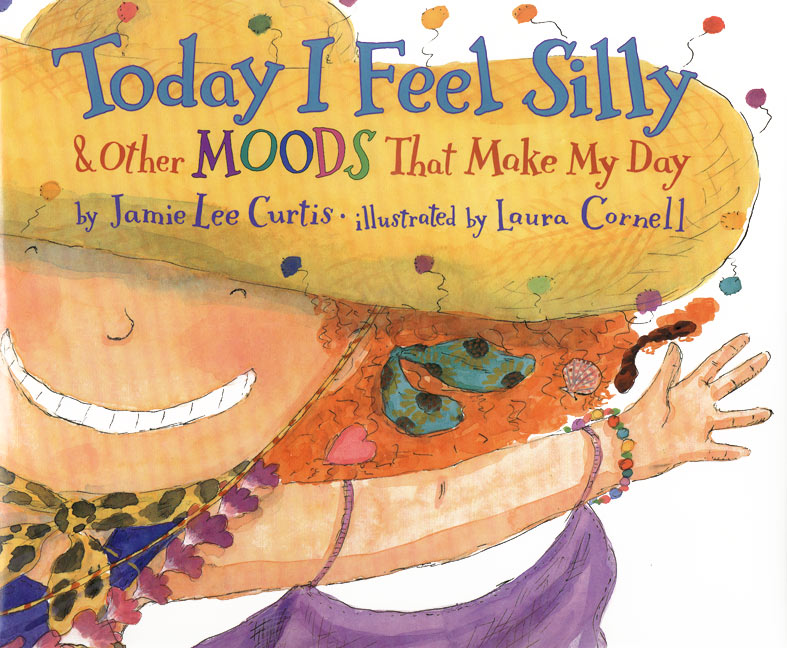
Today I feel Silly and Other Moods that Make My Day by Jamie Lee Curtis and Illusrated by Laura Cornell
Lesson Title: Moods/Emotions that Make My Day Lesson Plan
Grade Level and Subject: English-Language Arts – Kindergarten
Time allotted: 45 minutes
Materials and Supplies: Curtis, J. L. (1998). Today I feel silly & other moods that make my day. HarperCollins Publishing, large Emotions KWL Chart, large poster board for writing activity walk-through, student worksheets, markers, pencils, crayons, tape, various props for “engagement” phase (days of the week cards, silly clothes, music, etc.)
Objectives:
1. Students will be able to make predictions about the story by applying what they previously know about feelings/emotions.
2. Students will be able to individually connect emotional experiences from their personal lives by writing sentences about emotions as well as illustrating emotions and acting them out.
3. Students will be able to use more sophisticated vocabulary when referring to specific emotions and be able to fully comprehend each new words definition (for example, students will know that word “cranky” could be potentially used in place of the word “upset”).
4. Students will be able to articulate what behavioral and environmental clues help us understand and express emotions, such as body language, facial expressions, tone of voice, etc.
Rationale:
The focus of this lesson is to make certain that students will be able to identify emotions and feelings that they encounter on a day-to-day basis. This lesson gives children an opportunity to respond to literature through an interactive read aloud. As they listen to a story, students build comprehension skills and make personal connections from their own experiences. Students respond orally to the story by making predictions applying what they previously know about feelings/emotions, act out the emotions and sharing their personal reactions to the story as a group with different emotions. In all, students will enhance their vocabulary when referring to emotions.
Engagement Phase:
Teacher will begin by telling the students that they will be playing a short game that will require them to pay close attention. The teacher will explain that he/she will act out short scenes. Teacher will emphasize that the students must closely observe her behavior, her facial expressions, and other clues, such as props, to figure out what is going on in each scene.
Teacher will act out various emotions throughout the course of a “week”; these are the same emotions that will later be emphasized as new vocabulary words throughout the lesson. At the beginning of each scene, teacher will hold up a day of the week on an index card followed by a short scene portraying that emotion. On Monday, the emotion will be “cranky”. On Tuesday, the emotion is “silly”. On Wednesday, it is “discouraged”. On Thursday, it is “joyful”. On Friday, it is “excited”.
Students will be asked to explain what they saw in each scene. Teachers will ask prompting questions such as “What did you see happening on Wednesday? How did that differ from what happened on Monday?” “What kind of emotions did you think you saw in these scenes? What clues helped you figured out those emotions?”
After a student discussion about what happened in each scene and what types of emotions were present, teacher will reiterate that emotions change throughout time and that how we feel is sometimes connected to a specific situation (example: I am happy when I am at my friend’s birthday party).
Lesson:
1. Teacher introduces the storybook (Today I feel silly & other moods that make my day) by sharing the illustration on the cover (or title page), and draws students' attention to the title of the book. Students are asked to make predictions based on the title and connect it to their own past experiences with “moods” or “feeling silly”. Teacher will ask: “What do you think this story will be about?” Teacher may continue questioning: “Do you ever feel silly? What other feelings do you have today?”
2. The class will work together to fill out the K and W of the collective KWL chart about feelings. The “K” represents what they know about emotions/feelings. The “W” stands for when or where they feel these feelings. The “L” stands for what new emotions they encountered from this activity/book. In the “K” and “W” section the teacher will write all the emotions the students know and where/when they feel these emotions. The teacher highlights that everyone experiences many emotions and different events can encourage these specific emotions.
3. Teacher turns to the first page of book, pointing to where the text begins ("I'll begin right here"), and starts to read aloud. The teacher stops and explains unfamiliar vocabulary words throughout the story such as “rouge” on page 2, “grumpy” and “fern” on page 3. At the sixth page, after “anger” the teacher stops and asks: “Were our ideas about this book correct so far?” Before continuing to read aloud, ask: “Which of our emotions on our KWL chart were mentioned so far?”
4. The teachers reads continues to read until page 16, where he/she will pause to identify the unfamiliar words, “shaved” and crooked.” After reading 5 more pages, teacher will stop at the word “pizzazz”, explaining that it means a combination of strong energy and glamour. The teacher then completes the story and asks: “Can any of you remember feeling some of these emotions before?”
5. The teacher guides her students into a brief discussion reviewing the emotions stated in the story. Teacher will ask the students which new emotions they learned from the book. These new emotions will be written under the “L” on KWL chart; students can volunteer to write these new words on the chart. If not already included in the discussion and chart, teacher will make sure to add the words “silly”, “excited”, “discouraged”, “joyful” and “cranky”. These five words will be an integral part of the writing activity.
6. Before beginning writing assignment, teacher will model the sentence structure by doing a walk-through sample on large poster board (Ex. People can tell I am happy when I smiling and laughing.). Teacher will also do a quick drawing to show students how they can illustrate their original sentences.
The class will be split up into 5-6 groups. Each group will be given an unfamiliar emotion that they just recently learned (“silly”, “excited”, “discouraged”, “joyful” or “cranky”). Each student will work individually and write 1-2 sentence(s) describing when he or she remembers feeling that specific emotion.
Each student worksheet will have the new vocabulary word (such as discouraged) in dotted letters so students can trace these new words. Students must fill in the sight words “can”, “I”, and “am”, as well as describing the situations that cause their feelings. Additionally, each student will illustrate the situation and its corresponding emotion on their worksheets.
7. The class will reconvene at the end of the writing activity. Groups will volunteer to act out the emotions and situations that they described and illustrated on their worksheets. The students in the “audience” will give feedback by explaining how they knew what emotions were being acted out (ex: because of body language, the use of props, facial expressions, etc.)
Differentiated Instruction:
For students who are kinesthetic learners, the “acting out” sequence will allow them the opportunity for a more “hands on” approach to grasping the new emotions. Students, who are less kinesthetic or less interested “acting” in front of the class, will be allowed the opportunity to participate as an “audience” member.
ESL students will be encouraged to draw the illustration to their writing activity first. This may help them better formulate their ideas and corresponding vocabulary.
Assessment:
1. Teacher will pay close attention to student predictions being made about the story before the read-aloud. Additionally, teacher will listen to students’ responses to questions he/she poses throughout the read aloud. Emphasis will be placed on students’ ability to link their past emotional experiences to the story.
2. Teacher observes what the students illustrated on the handout and evaluates if it relates to that specific emotion. The teacher also observes how the students act out the emotion given to their group.
3. Teacher listens to student explanations of different emotions, making sure that students are using the newly learned terminology appropriately.
4. Teacher will listen to the explanations of the “audience” during the acting scenes. Students in the audience should be able to explain clues that lead them to their conclusions about the portrayed emotions—such as looking at facial expressions, body language, tone of voice, etc.
Common Core Standards Addressed:
Students, with prompting and support, will ask and answer questions about emotions and about the situations that influence them. Common Core Reading Standards for Kindergarten, Key Ideas and Details (#1)
Students will ask and answer questions about unknown words in “Today I feel silly & other moods that make my day”, such as the word “rogue” on page 3. Common Core Reading Standards, Craft and Structure (#4)